
Red Light Basics
Understanding 660 nm and 850 nm Red Light
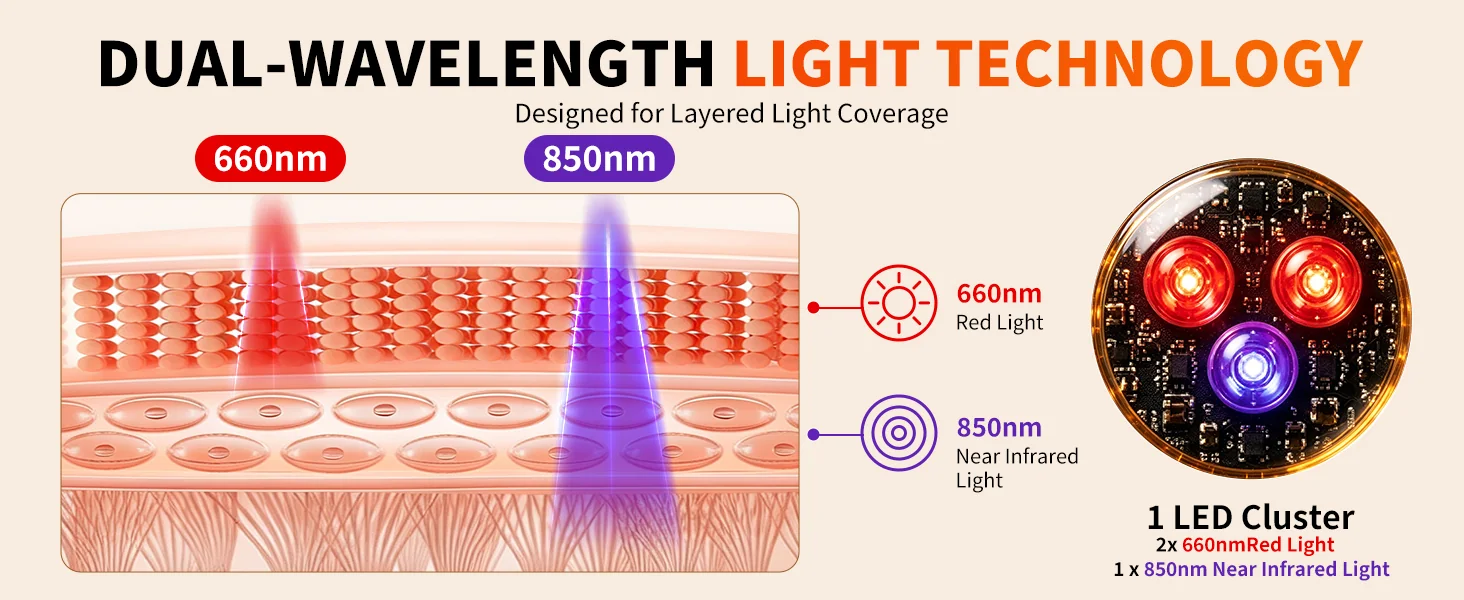
660 nm is visible red light; 850 nm is near-infrared and may look dim even when active. The LED component sheet used for the current rePretty Mat specifies red peaks from 650 to 665 nm and infrared peaks from 840 to 860 nm. Those component values identify the two light bands used by the current mat and help explain why the infrared channel looks dimmer to the eye.
In this guide
Understand the two light bands and what they mean in everyday use.
- Why the 850 nm channel looks dim
- What the component specification confirms
- What else matters when choosing a routine
Evidence snapshot
Component specification for model ZH5050-2RIR-04 at its stated bench-test condition.
Near-infrared output is mostly outside normal human vision, so it may appear dim.
Each package contains two red channels and one infrared channel in the component design.
01
What 660 nm and 850 nm describe
Nanometers measure wavelength. Light near 660 nm falls in the visible red region. Light near 850 nm is near-infrared, beyond most normal human vision, so the infrared channel can be active without looking as bright as the red channel.
Visual brightness is therefore a poor way to compare the two channels. Optical instruments, not eyesight or a phone camera, are needed to measure output.
02
What the rePretty component sheet confirms
The ZH5050-2RIR-04 component specification lists two red channels with peak wavelengths from 650 to 665 nm and one infrared channel from 840 to 860 nm. At the component's 20 mA test condition, typical radiant flux is listed as 16 mW for each red channel and 10 mW for the infrared channel, with a 120-degree viewing angle.
In everyday use, the visible red and near-infrared channels work together across the mat. The red channel is easy to see, while much of the 850 nm near-infrared light sits outside normal human vision, so brightness alone is not a useful comparison.
03
Why wavelength does not equal penetration depth
Near-infrared light is generally less absorbed by some superficial chromophores than visible red light, which is one reason it is studied for deeper targets. But there is no single honest statement such as 850 nm penetrates a fixed number of inches.
Depth depends on tissue type, pigmentation, blood content, device output, beam spread, contact, and the measurement method. A wavelength label alone cannot tell a buyer how much energy reaches a target tissue.
04
What to compare beyond wavelength
For a home mat, compare the actual dimensions, contact guidance, controls, timer range, modes, included accessories, cleaning, storage, warranty, and whether the format fits the way you plan to use it.
For the current rePretty Mat, the product information supports 660 nm and 850 nm bands, constant, 10 Hz and 40 Hz modes, five levels, and a 10-to-90-minute timer. Use those confirmed controls and the manual when planning a routine.
References
Sources
- 01Proposed Mechanisms of Photobiomodulation or Low-Level Light Therapy
Wavelength, absorption, signaling, and dose dependence.
- 02Photophysical Mechanisms of Photobiomodulation Therapy as Precision Medicine
Why wavelength-tissue interactions are more complex than a fixed penetration claim.
- 03rePretty Full-Body Red Light Therapy Mat
Current finished-product controls and the ZH5050-2RIR-04 component specification reviewed by rePretty.
Continue learning
Related guides
Use the next guide to answer the practical question that follows from this one.
Need a format starting point?