
Everyday Routines
Building a Calmer Evening Routine Around Red Light
Use an evening red light session as a cue to reduce stimulation, not as a treatment for insomnia. Keep the room dim, silence work notifications, use a conservative 10-to-20-minute manual-based setting, and leave time to cool down before bed. Human studies show that longer-wavelength evening light can reduce melatonin suppression, but red light has not produced consistently better sleep.
In this guide
The strongest routine is the one that reduces stimulation around the session.
- Dim the room and silence work
- Keep the session simple and repeatable
- Treat red light as a cue, not a guaranteed sleep solution
Evidence snapshot
Blue-depleted light reduced melatonin suppression but did not improve total sleep time.
One hour of red light produced mixed sleep and mood effects across healthy and insomnia groups.
Four weeks of 850 nm exposure did not significantly improve sleep or circadian outcomes.
01
A practical 45-minute wind-down
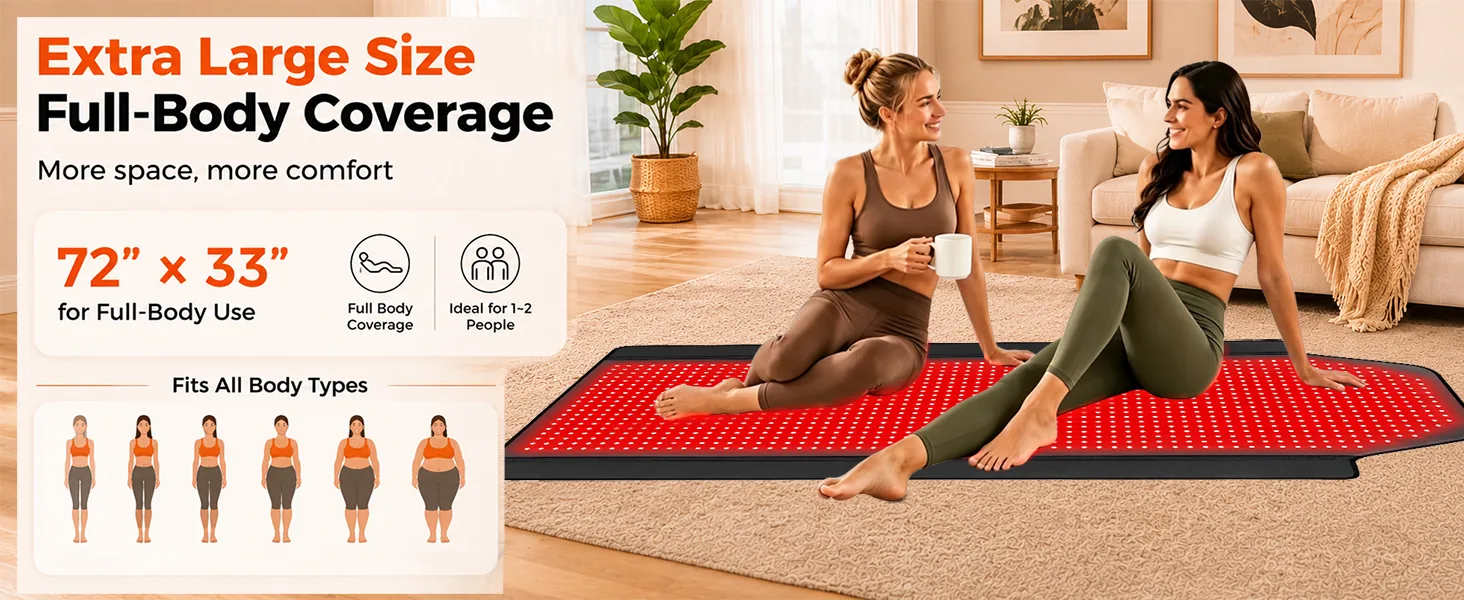
About 45 minutes before bed, lower the room light and finish active work. Use the mat for 10 to 20 minutes at a comfortable manual-based setting, then power down, clean or fold it as directed, and spend the remaining time on a quiet transition such as reading, stretching, or preparing for the next day.
Keep wake time and bedtime reasonably consistent. Avoid turning the session into another performance score or extending it because sleep has not arrived yet.
- Minute 0-5: close work, dim room lights, silence notifications.
- Minute 5-25: use the mat at a comfortable starting setting.
- Minute 25-30: power down and store the device safely.
- Minute 30-45: quiet transition with minimal bright-screen exposure.
02
Longer-wavelength light is not the same as a sleep treatment
In a 2017 randomized crossover study of 16 healthy adults, blue-depleted evening light at the same 50-lux corneal illuminance reduced melatonin suppression from 56.5% under fluorescent light to 24.6%. It did not significantly improve total sleep time, sleep efficiency, or slow-wave activity.
This study helps explain why evening light choices matter, while its sleep-duration and sleep-efficiency measures did not significantly change.
03
Direct red-light sleep results are mixed
A 2023 study randomized 57 people with insomnia symptoms and 57 healthy participants to red, white, or dark conditions for one hour before bed. Some sleep-onset measures improved relative to white light, but red light also worsened sleep efficiency or other sleep measures in several comparisons and increased negative emotion in some groups.
A separate double-blind home trial tested 850 nm doses of 1, 4, and 6.5 J/cm2, five days per week for four weeks. It found winter well-being effects at the highest dose but no significant sleep or circadian benefit.
04
When sleep needs more than a routine
Persistent insomnia, loud snoring, breathing pauses, restless legs, severe daytime sleepiness, or mood symptoms deserve professional evaluation. A home wellness routine should not delay investigation of a sleep disorder or another medical cause.
References
Sources
- 01The Effects of Spectral Tuning of Evening Ambient Light
Blue-depleted light reduced melatonin suppression without improving measured sleep outcomes.
- 02Effects of Red Light on Sleep and Mood
One-hour pre-bed red light produced mixed sleep and mood findings in 114 participants.
- 03Effects of Near-Infrared Light on Well-Being and Health
Four-week 850 nm home exposure did not significantly improve sleep or circadian outcomes.
- 04NHLBI Healthy Sleep Habits
Consistent schedule, lower evening stimulation, and a sleep-supportive environment.
Continue learning
Related guides
Use the next guide to answer the practical question that follows from this one.
Need a format starting point?