
Red Light Basics
Red Light Therapy Basics: What Photobiomodulation Means
Photobiomodulation, or PBM, uses non-ionizing red or near-infrared light. The research spans LEDs and lasers, wavelengths roughly from 600 to 1100 nm, and highly varied doses and treatment areas. A useful reading rule is therefore simple: match the study's wavelength, irradiance, time, body area, and population before applying its result to a home device.
In this guide
A wavelength label is the beginning of a protocol, not the whole protocol.
- What PBM means in research
- The six parameters needed to compare studies
- How device design and routine shape real-world use
Evidence snapshot
A broad research range, not a promise that every wavelength or device performs the same way.
Only eleven heterogeneous self-applied device studies met the review criteria.
The panel used two Delphi rounds and two consensus meetings for selected clinical applications.
01
What photobiomodulation means
Photobiomodulation is the modern umbrella term for using low-intensity red or near-infrared light to influence biological processes without the tissue heating or cutting associated with surgical lasers. Older papers may call it low-level laser therapy or LLLT. Both LEDs and lasers appear in the literature.
Sharing a category name does not make the devices interchangeable. A clinic laser, a desk lamp, a panel, a wearable, and a full-body mat can differ in beam shape, contact, area, irradiance, pulse pattern, session time, and total energy.
02
The six numbers that make a protocol interpretable
At minimum, look for wavelength, irradiance or power density, fluence or energy density, exposure time, treatment area, and frequency. Distance or contact condition and pulse settings can also materially change what reaches the tissue.
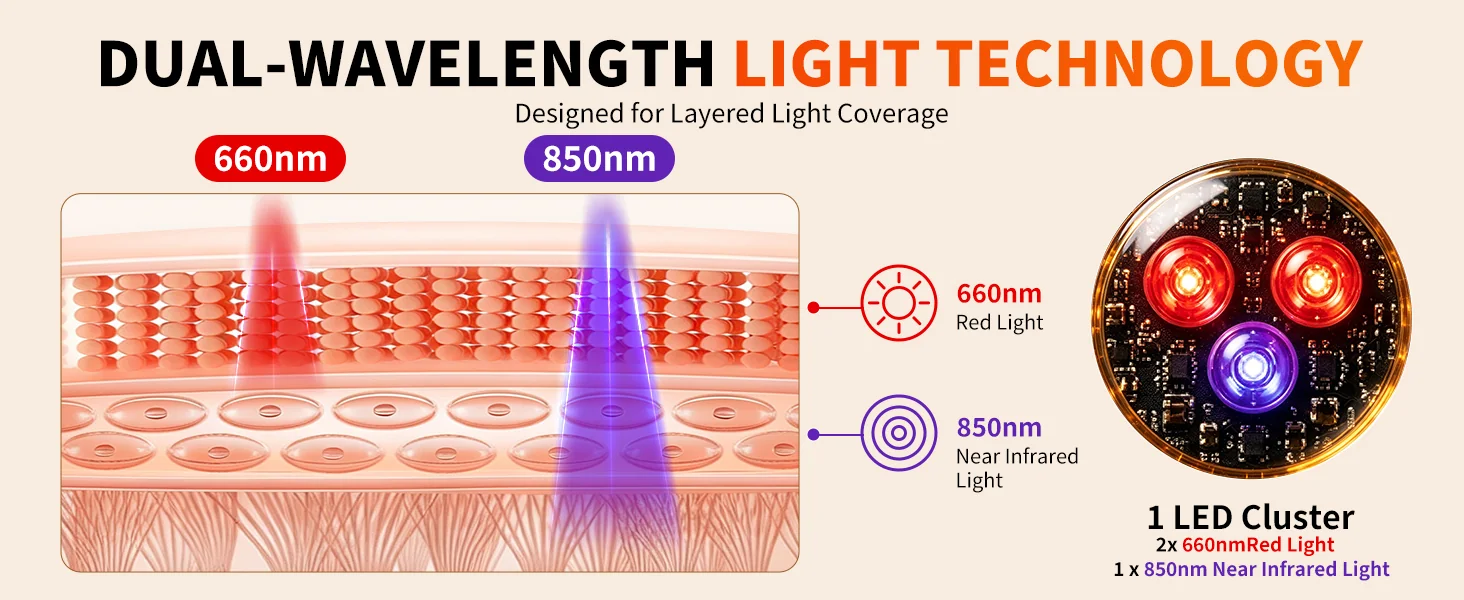
If a page shows only 660 nm or 850 nm and a timer, it has not provided enough information to reconstruct the dose used in a paper.
- Wavelength: which part of the spectrum was used.
- Irradiance: optical power reaching each square centimeter.
- Fluence: accumulated energy per square centimeter.
- Time and frequency: minutes per session and sessions per week.
- Area and geometry: body site, contact, distance, and beam spread.
- Population and outcome: who was studied and what was measured.
03
What the home-use evidence actually looks like
A 2019 systematic review found only 11 eligible studies of self-applied home PBM devices across multiple indications. Most reported favorable findings, but devices, endpoints, and protocols varied, and the authors called for more randomized trials.
That is useful evidence that home use has been studied. It is not evidence that every home device shares the same effective schedule or result.
04
How to read an outcome without exaggerating it
A 2017 pain meta-analysis included 18 studies and 1,462 adults and found pooled improvement, but heterogeneity was high and the work largely involved localized clinical laser protocols. A 2025 review of whole-body PBM found only five studies with 105 active participants and did not find performance or fatigue-biomarker benefits.
The practical lesson is not that PBM works or does not work as a single yes-or-no category. It is that outcome, device, dose, body area, and population have to stay connected.
References
Sources
- 01Proposed Mechanisms of Photobiomodulation or Low-Level Light Therapy
Mechanisms, protocol variables, and biphasic dose response.
- 02Photobiomodulation: Lasers vs Light Emitting Diodes?
Why LED and laser sources can both be used while delivery and dosimetry still matter.
- 03Therapeutic Efficacy of Home-Use Photobiomodulation Devices
Eleven heterogeneous home-use studies and the need for additional randomized trials.
- 04Evidence-Based Consensus on the Clinical Application of Photobiomodulation
A 21-expert Delphi consensus for selected clinical applications and adult safety.
Continue learning
Related guides
Use the next guide to answer the practical question that follows from this one.
Need a format starting point?